

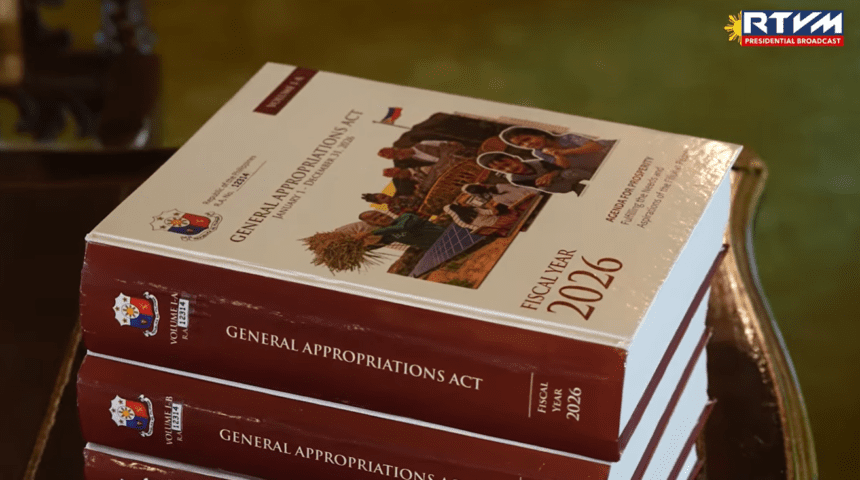
MANILA, Philippines — President Ferdinand Marcos Jr. has officially signed the ₱6.793-trillion national budget for 2026, but not without wielding his veto power to strike down nearly ₱92.5 billion in “unprogrammed” line items.
During the ceremonial signing of Republic Act No. 12314 on Monday, Jan. 5, the President emphasized a shift toward stricter fiscal discipline, declaring that unprogrammed appropriations (UA) should never be treated as “blank checks.”
“To ensure that public funds are expended in clear service of national interest, I vetoed several items of appropriations… totaling almost ₱92.5 billion,” Marcos announced. He noted that this reduction brings unprogrammed funds to their lowest level since 2019.
Safeguarding Public Funds
The President’s decision targets the UA—a portion of the budget that is only funded when the government exceeds its revenue targets or secures additional foreign loans. Critics have often labeled these funds as a “backdoor” for discretionary spending.
Marcos was firm in his stance against such perceptions. “We will not allow the unprogrammed appropriations to be misused,” he said. “Its utilization is provided with safeguards and is only available when clearly defined triggers and tests are met.”
What was Cut?
Executive Secretary Ralph Recto clarified that roughly 10 major items were removed from the UA list. Notable vetoes include:
- ₱80 billion: Strengthening Assistance for Government Infrastructure and Social Programs (SAGIP)
- ₱6.7 billion: Public health emergency benefits
- ₱4.32 billion: Fiscal support for the Comprehensive Automotive Resurgence Strategy (CARS) program
- ₱2 billion: Marawi Siege Victims Compensation
- ₱2 billion: Insurance for government assets
Despite these cuts, Recto assured the public that essential services would remain unaffected. He explained that because the government’s revenue targets are already set high, there is unlikely to be enough “excess revenue” to trigger these unprogrammed funds anyway.
“I believe what we will collect will be just enough for the programmed projects. There isn’t much excess revenue, so those items under unprogrammed funds are not necessary,” Recto said in Filipino.
Transition from 2025
The 2026 budget, originally delayed due to extensive executive review, succeeds the 2025 General Appropriations Act, which was briefly re-enacted at the start of the year.
The President has directed the Department of Budget and Management (DBM) to ensure a smooth transition, accounting for all lawful expenditures incurred during the first few days of January under the previous year’s budget.
The administration maintains that the 2026 budget—the largest in Philippine history—is designed to foster inclusive growth while maintaining a “bare minimum” approach to discretionary funding.